
PTFE film is a thin, non-porous fluoropolymer sheet made from polytetrafluoroethylene, and it stands as the ultimate insulation choice for demanding wire and cable applications. Its low dielectric constant of about 2.1 remains stable across frequencies and temperatures, according to Polyfluoro Ltd. A continuous service rating of 260°C, with brief excursions above 300°C, plus near-total chemical inertness complete the case. This guide helps engineers and buyers make three practical decisions: material selection, specification, and processing of ptfe cable film.
What Is PTFE Film?
1 Definition and Composition
PTFE film is a thin sheet of polytetrafluoroethylene, a high-performance fluoropolymer built from tetrafluoroethylene. The molecule forms a long chain of repeating [CF2-CF2] units. Versiv Composites explains how this structure produces the film’s signature behavior.
| Structural feature | Contribution to properties |
|---|---|
| Carbon backbone | A strong carbon-carbon chain supports a stable outer layer and gives non-stick release performance |
| Fluorine shield | A dense helical sheath of fluorine atoms repels other materials and lowers friction |
| Steric protection | Tight fluorine packing blocks outside molecules from reaching the carbon core, so chemicals and heat struggle to break the polymer down |
| Few mobile charge carriers and low moisture absorption | Excellent dielectric properties and electrical insulation |
| Strong carbon-fluorine bonds | Resistance to ultraviolet radiation and minimal photochemical degradation outdoors |
How PTFE Film Is Manufactured
Skiving is the most common route. A sintered PTFE billet mounts on a rotating mandrel, and a knife blade peels off thin layers from the surface. The blade advances along the block and removes a thin layer with each pass. Bladen PTFE reports that skiving produces flat film with thicknesses as low as 0.001 inches.
Turning works on the same principle with a continuous, ultra-sharp linear blade. PTFE expands roughly ten times more than most metals under heat, so turning heat can shift dimensions and create uneven thickness. Yaxing Flon notes that CNC-controlled skiving holds tolerances of plus or minus 0.01 mm for film under 0.5 mm. Standard PTFE cannot melt extrude, so manufacturers rely on skiving or dispersion calendering.
Forms and Formats for Cable Use
Suppliers convert PTFE into several formats for ptfe cable film duties. Evantic lists unsintered tapes for critical wire and cable, skived sintered film for interwire slip layers, and expanded PTFE for high-frequency coaxial cables. Conductive unsintered tapes serve shielding and grounding, and laser-markable tapes support wire identification.
Key Properties for Wire and Cable
Electrical Performance
Signal integrity depends on how well an insulation material stores and releases electrical energy. PTFE film excels here. Its dielectric constant sits near 2.0 to 2.1, one of the lowest values among solid insulating materials. PCB Tok reports that this value stays stable from direct current up to millimeter-wave frequencies, with testing at 40 GHz showing barely any change. The dissipation factor, or loss tangent, measures roughly 0.0002 to 0.0004. That low loss means very little signal energy converts to heat inside the insulation.
| Property | Value | Frequency note |
|---|---|---|
| Dielectric constant (pure PTFE) | 2.0 to 2.1 | Stable from DC up to millimeter-wave frequencies |
| Dielectric constant (commercial PTFE composites) | 2.2 to 3.5 | — |
| Dissipation factor (loss tangent) | 0.0002 to 0.0004 | — |
Thermal Stability
PTFE film serves continuously at 260°C and tolerates brief excursions above 300°C. Those ratings matter in aircraft engines, industrial ovens, and downhole tools, where insulation must survive heat that would degrade PVC or polyethylene in minutes.
| Metric | Value |
|---|---|
| Thermal expansion/contraction rate | within ±1% in both directions |
| Thermal cycling range (cryogenic) | -253°C to +150°C |
Chemical and Environmental Resistance
PTFE film resists attack from nearly every industrial chemical. No known solvent dissolves the polymer at room temperature. Only molten alkali metals and fluorine gas at elevated temperatures react with it.
| Chemical / Medium | Test Conditions | Result |
|---|---|---|
| Chlorinated solvents | 1-year immersion at 25°C | No swelling (<0.01% volume change) |
| Strong oxidizers | >10,000 hours at 25°C | Stable; limited attack only at >150°C |
| Concentrated sulfuric acid (98%) | 80°C, 30 days | Weight change <0.05% |
PTFE Cable Film Applications
Cable Types
- Coaxial & RF Cables
- Aircraft Wiring
- Automotive Harnesses
- 5G Millimeter-wave Assemblies
Key Sectors
- Aerospace navigation
- Electric & Hybrid platforms
- Telecommunications (5G)
- Spacecraft electronics
PTFE high-speed cable film plays a substantial role in the aerospace sector thanks to its distinctive properties. Its strong insulation durability and superb heat resistance make it suitable for electrical applications within aircraft systems.
PTFE Film vs. Alternative Materials
| Property | PTFE | Polyimide | FEP | Silicone |
|---|---|---|---|---|
| Max Temp | 260°C | 260°C | 200°C | 200°C |
| Chem Resist | Highest | High | Highest | Moderate |
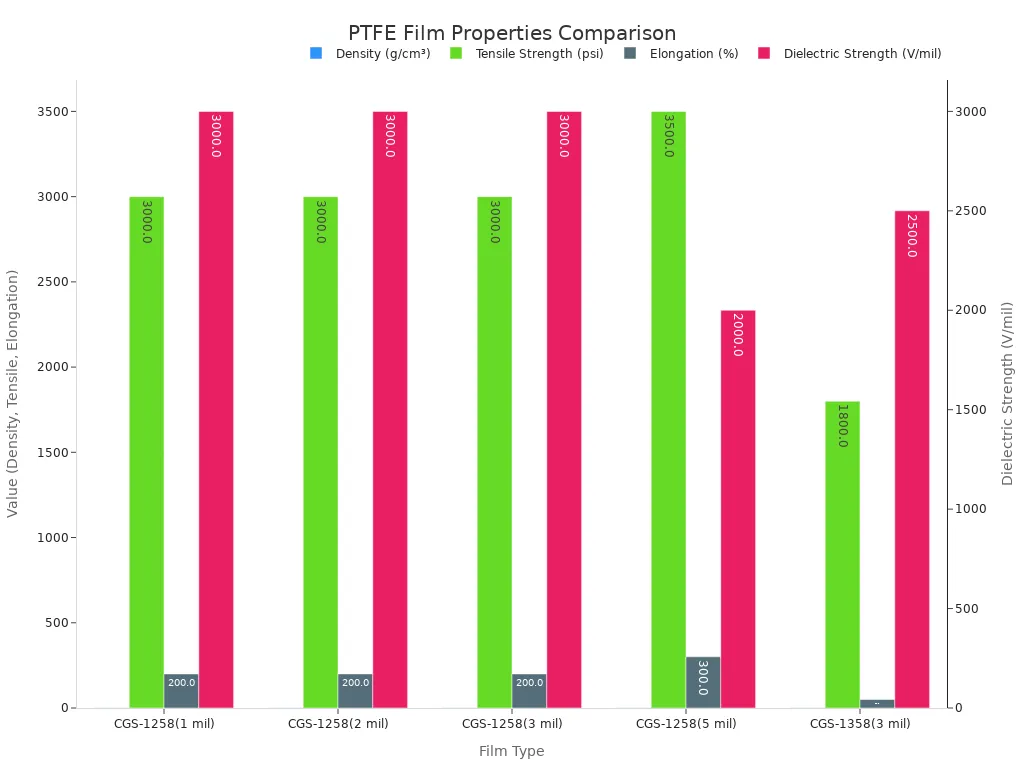
Selection and Specification Guide
Key Specifications to Request
| Product Number | Film Type | Density (g/cm³) | Tensile (psi) | Dielectric (V/mil) |
|---|---|---|---|---|
| CGS-1258 (1 mil) | 1 Mil Skived | 2.13–2.19 | 3000 | 3000 |
| CGS-1358 (3 mil) | 3 Mil Unsintered | 1.50–1.70 | 1800 | 2500 |
Installation and Processing
Best Practices
- Use multiple layers where thermal or abrasion risk runs highest.
- Avoid adhesives that migrate under heat or oils.
- Store in cool, dry environment (15°C – 25°C), humidity < 60%.
- Sintering profile must match tape thickness and conductor mass.
FAQ
What makes PTFE film suitable for wire and cable insulation?
PTFE film offers a dielectric constant near 2.1, continuous service at 260°C, and near-total chemical inertness. These properties hold stable across frequency and temperature extremes.
Does PTFE film work at both high and low temperatures?
PTFE film serves continuously at 260°C and tolerates brief excursions above 300°C. The material also remains flexible near -200°C without turning brittle.
Which film format suits a given cable design?
Skived sintered film fits wrapping operations that need a dense, void-free layer. Unsintered tape conforms tightly to conductors and fuses during sintering. Expanded PTFE lowers the effective dielectric constant for low-loss coaxial cables.
Post time: Oct-27-2026